

Voice AI Agents for Business: Automating 24/7 Customer Phone Support
Voice AI agents let your business answer phone calls, handle inquiries, and complete tasks using natural-sounding AI conversations instead of hold music or voicemail. In 2026, voice AI has crossed the quality threshold where callers often cannot tell the difference. Platforms like LaunchLemonade offer voice agents alongside chat agents, so you can serve customers however they prefer to communicate. Here is what voice AI can do for your business and how to get started.
What Is a Voice AI Agent?
A voice AI agent is an AI-powered assistant that communicates through spoken conversation instead of (or in addition to) text chat. It can answer phone calls, respond to voice queries, and complete tasks through natural dialogue. Unlike old-school phone trees (“Press 1 for sales”), voice AI agents understand natural language and respond conversationally.
The technology behind voice AI combines three capabilities:
- Speech-to-text converts the caller’s voice into text the AI can process
- Language processing generates an intelligent, contextual response
- Text-to-speech converts the response back into natural-sounding voice
On platforms like LaunchLemonade, voice agents use the same knowledge base and instructions as your chat agents. Train it once, deploy it across both channels.
Why Does Voice AI Matter for Small Businesses?
Voice AI matters because 62% of customers still prefer calling a business for complex questions, urgent issues, or when they need immediate help. Text chat is great for simple queries, but voice remains the default for many customer interactions.
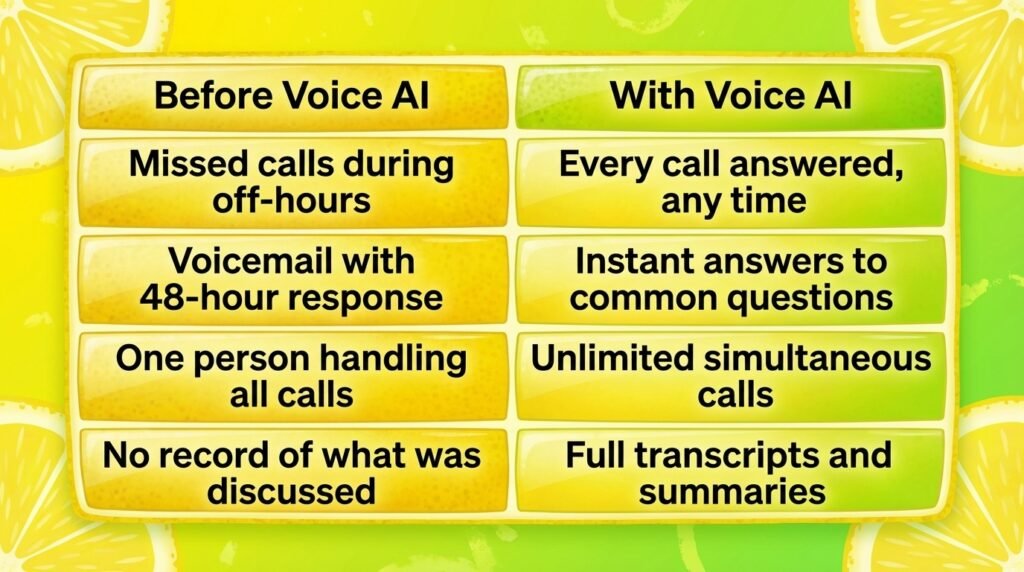
The problem: small businesses cannot afford to staff a phone line 24/7. The result is missed calls, voicemail boxes that never get checked, and customers who call your competitor instead.
Voice AI solves this by providing:
- 24/7 phone coverage without hiring staff
- Instant answers drawn from your actual business knowledge
- Consistent quality whether it is the first call or the hundredth
- Call summaries so your team knows exactly what was discussed
What Can Voice AI Agents Actually Do in 2026?
Voice AI in 2026 handles far more than basic FAQ responses. Here is what a well-trained voice agent can do today.
Answer customer questions. Using your knowledge base, the agent provides accurate answers about your services, pricing, availability, and policies.
Schedule appointments. The agent can walk callers through available time slots and book meetings directly into your calendar.
Qualify leads. Ask callers about their needs, budget, and timeline, then route qualified leads to your team with full context.
Provide order status. For businesses with order tracking, the agent can look up and share order information.
Handle after-hours calls. Capture caller information and key details so your team can follow up during business hours.
Triage urgent issues. Identify truly urgent situations and escalate them to a human immediately, while handling routine calls independently.
How Do You Set Up a Voice AI Agent?
Setting up a voice AI agent follows the same general process as building a chat agent, with a few voice-specific considerations.
Step 1: Start With Your Chat Agent
If you already have a chat agent on a platform like LaunchLemonade, you are most of the way there. Your knowledge base, instructions, and boundaries apply to both channels. Enable voice and your chat agent becomes a voice agent using the same training.
Step 2: Adjust for Voice Conversation Style
Voice conversations are different from chat. Add these voice-specific instructions:
- Keep responses concise. A 200-word chat response works fine to read. Spoken aloud, it takes over a minute and loses the caller. Aim for responses under 30 seconds of speaking time.
- Use natural speech patterns. “Let me check that for you” sounds more natural than “Processing your request.”
- Confirm key information. “Just to confirm, you said your business is located in Denver. Is that correct?” Mishearing a word in voice is more common than misreading in chat.
- Offer to repeat. “Would you like me to repeat that, or would it help if I sent a summary to your email?”
Step 3: Test With Real Calls
Call your own voice agent multiple times. Test with different accents, speaking speeds, and background noise levels. Check that:
- The agent understands questions correctly
- Responses sound natural when spoken aloud
- Handoffs to humans work smoothly
- The agent handles interruptions and crosstalk gracefully
Step 4: Set Up Call Routing
Decide how calls reach your voice agent:
- Dedicated phone number that routes directly to the AI agent
- After-hours routing where calls go to AI outside business hours
- Overflow routing where AI picks up when your team is busy
- Front-line triage where AI handles initial screening before transferring to humans
What Are the Limitations of Voice AI in 2026?
Voice AI has improved dramatically, but it still has limitations you should understand.
Accents and dialects. Speech recognition accuracy drops with strong accents or regional dialects. Test with your actual customer base, not just standard American English.
Background noise. Callers in noisy environments (cars, restaurants, construction sites) can be harder for voice AI to understand.
Emotional conversations. Angry or upset callers need human empathy. Your voice agent should recognize frustration and offer to transfer to a human team member quickly.
Complex multi-party calls. Voice AI works best in one-on-one conversations. Conference call scenarios are still challenging.
Legal compliance. Some jurisdictions require disclosure that the caller is speaking with an AI. Check your local regulations and configure your agent to disclose its nature at the start of calls.
Frequently Asked Questions
How much does a voice AI agent cost?
Voice AI agent costs vary by platform. On LaunchLemonade, voice agents are included alongside chat agents starting at $25/month. Some platforms charge per minute of call time, which can add up. Compare pricing models before choosing a platform.
Can customers tell they are talking to AI?
In 2026, voice AI quality has reached a point where many callers do not immediately recognize they are speaking with AI. However, best practice is to disclose it. Most customers are fine with AI as long as it actually solves their problem and provides a clear path to a human when needed.
Do voice AI agents work with my existing phone system?
Most voice AI platforms offer phone number provisioning or integration with existing phone systems. The setup varies by platform, but you typically either get a new phone number or route your existing number to the AI agent during specific hours.
Can a voice AI agent handle multiple calls at the same time?
Yes. Unlike a human receptionist who can only handle one call at a time, a voice AI agent can handle unlimited simultaneous calls. This is especially valuable during peak hours or for businesses that receive a high volume of phone inquiries.
What happens when the voice AI cannot help a caller?
A properly configured voice agent recognizes its limitations and offers to transfer the caller to a human team member. If no one is available, it collects the caller’s information and key details, then ensures your team follows up. On platforms like LaunchLemonade, full transcripts are available so your team has complete context.