
How to Build a Multi-Agent AI Team for Your Business
A multi-agent AI team is a group of specialized AI assistants that work together to handle different parts of your business. Instead of one assistant trying to do everything, you build focused agents for support, research, onboarding, and more. Platforms like LaunchLemonade let you create multi-agent workflows in minutes with no code. Here is how to plan, build, and connect your first AI team.
What Is a Multi-Agent AI Team?
A multi-agent AI team is a set of specialized AI assistants that each handle one specific function in your business and pass work between each other automatically. Think of it like departments in a company. Your support agent handles customer questions, your research agent prepares briefings, and your onboarding agent walks new clients through setup.
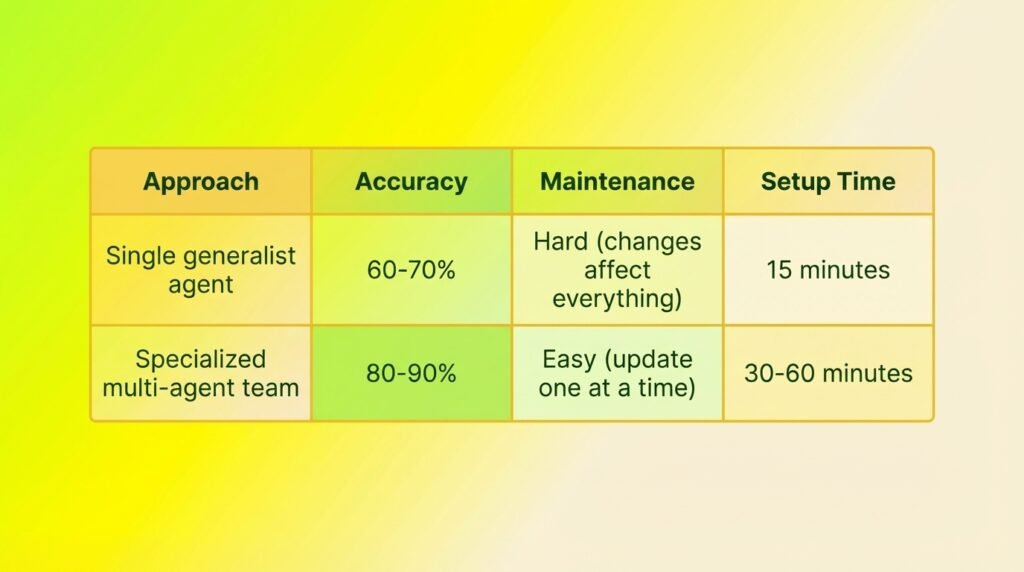
The key difference from a single all-purpose assistant: specialized agents outperform generalists by 40-60% on task accuracy because each one is trained on a focused knowledge base with specific instructions.
On platforms like LaunchLemonade, these agents can hand off conversations, share context, and collaborate on workflows without any coding or API setup.
Why Should You Use Multiple AI Agents Instead of One?
You should use multiple agents because a single assistant trying to handle everything performs worse than specialized agents working as a team. Here is why.
The generalist problem: When you load one assistant with your entire knowledge base (support docs, sales scripts, HR policies, product specs), it has to search through everything for every question. Response quality drops. Accuracy drops. The assistant gives mediocre answers to everything instead of excellent answers to specific things.
The specialist advantage: When each agent has a focused purpose, a smaller knowledge base, and specific instructions, three things improve:
- Accuracy goes up. Less irrelevant information means better answers
- Response speed improves. Smaller knowledge bases are faster to search
- Maintenance is easier. Update one agent without affecting the others
What Agents Should You Build First?
Start with two to three agents that cover your most time-consuming tasks. Do not try to build ten agents on day one. Here is a priority framework based on what works for most small businesses.
The Starter Team (Build These First)
Agent 1: Customer Support
– Purpose: Answer common questions about your products, services, pricing, and policies – Knowledge base: FAQ document, service descriptions, pricing guide – Expected impact: Saves 5-15 hours per week
Agent 2: Client Onboarding
– Purpose: Walk new clients through your setup process, collect required information, answer onboarding questions – Knowledge base: Onboarding checklist, welcome guide, setup instructions – Expected impact: Saves 4-10 hours per week
Agent 3: Research and Prep
– Purpose: Summarize documents, prepare meeting briefs, compile background information – Knowledge base: Client files, project documents, company resources – Expected impact: Saves 3-8 hours per week
The Growth Team (Build These After the Starter Team Is Running)
- Lead qualification agent that scores inbound inquiries
- Content research agent that helps prepare blog posts and reports
- Internal knowledge agent that answers team questions about processes and policies
How Do You Connect Multiple Agents Into a Workflow?
Connecting agents into a workflow means defining how they pass information and tasks between each other. On a no-code platform, this is configuration, not coding.
Step 1: Map your workflow. Draw out the process on paper first. For example: Lead comes in > Support agent qualifies > If qualified, Onboarding agent takes over > If complex question, Research agent provides data.
Step 2: Define handoff triggers. Each agent needs to know when to pass a conversation to another agent. Examples:
- “If the customer asks about pricing for custom solutions, hand off to the sales agent”
- “If the client has completed onboarding steps 1-3, transfer to the account setup agent”
- “If the question requires data from project files, send to the research agent”
Step 3: Build each agent separately. Give each one its own knowledge base, instructions, and boundaries. Test each agent independently before connecting them.
Step 4: Connect and test the full workflow. Run test scenarios end to end. Check that handoffs happen at the right moments, context transfers correctly, and no conversations get dropped.
What Are the Common Mistakes When Building Multi-Agent Teams?
These five mistakes cause most multi-agent setups to underperform. Avoid them from the start.
Mistake 1: Building too many agents at once. Start with two or three. Add more only after your starter team is working well.
Mistake 2: Overlapping knowledge bases. If two agents have the same documents, they might give conflicting answers. Keep knowledge bases focused and non-overlapping.
Mistake 3: Unclear handoff rules. Vague triggers like “if the question is complicated” lead to confused routing. Use specific, testable conditions instead.
Mistake 4: No fallback for unhandled queries. Every agent needs a rule for what happens when it cannot help. The default should be: collect contact information and escalate to a human.
Mistake 5: Never testing end to end. Individual agents might work perfectly in isolation but fail when connected. Always test the complete workflow with realistic scenarios.
How Much Does a Multi-Agent AI Team Cost?
A multi-agent team on a no-code platform costs significantly less than hiring additional staff or building custom software.
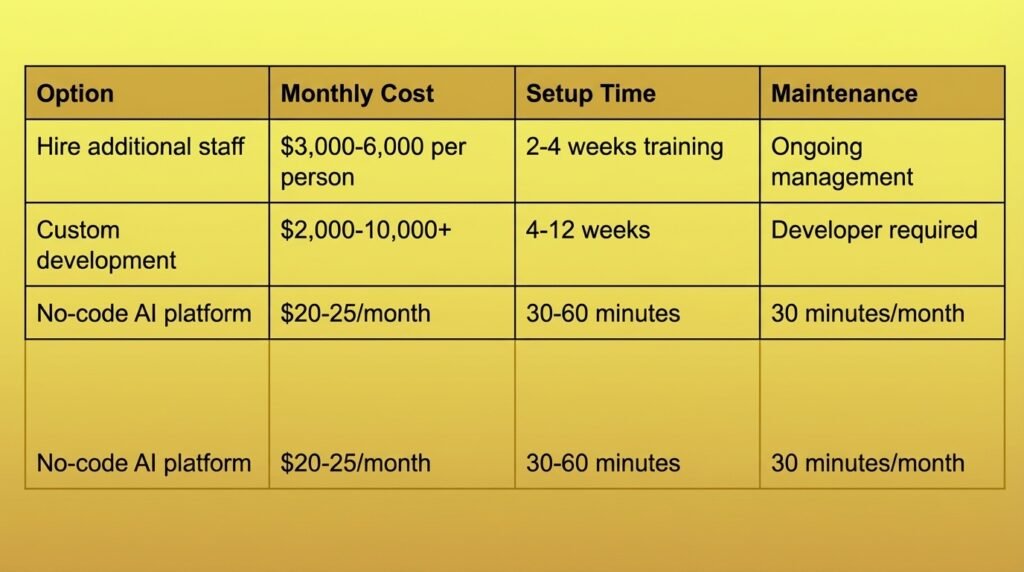
On LaunchLemonade, you can build multiple agents on any plan starting at $25/month. The team plan at $20/seat/month includes collaboration features for businesses where multiple team members manage the AI agents.
For a business owner spending 20+ hours per week on tasks that agents could handle, the return on investment is clear within the first week.
Frequently Asked Questions
How many AI agents should a small business start with?
Start with two to three agents focused on your biggest time sinks. Most businesses begin with a customer support agent and a client onboarding agent. Add more agents only after your initial team is running smoothly and you have identified the next highest-impact use case.
Can multiple AI agents work together automatically?
Yes. On platforms with multi-agent orchestration like LaunchLemonade, agents can hand off conversations, share context, and route tasks between each other automatically based on rules you define. No coding required.
Do I need different AI models for different agents?
It depends on the task. Customer support benefits from fast, accurate models. Research and analysis benefits from models with stronger reasoning capabilities. Platforms like LaunchLemonade offer 21+ LLMs so you can assign the best model to each agent based on what it needs to do.
How long does it take to set up a multi-agent team?
On a no-code platform, plan for 30 to 60 minutes to build and connect your first two to three agents. Each additional agent takes about 15 minutes to configure. Testing the full workflow adds another 15-30 minutes.
What happens when an AI agent cannot answer a question?
A well-configured agent has a fallback rule: it collects the customer’s contact information, acknowledges the limitation, and escalates to a human team member. On governed platforms like LaunchLemonade, every conversation is logged so your team can review what happened and improve the agent’s knowledge base.