
An AI agent builder is a platform that lets you create AI-powered assistants for your business, all without writing code. Unlike chatbots that follow scripts, AI agents reason through tasks, connect to your business knowledge, and act autonomously. If you’ve ever wished you could hire someone who already knows your business and never sleeps, that’s what you’re building.
What Is an AI Agent Builder?
An AI agent builder is a platform that lets you create AI-powered assistants for specific business tasks, such as answering client questions, drafting proposals, or handling onboarding, without writing code. Unlike chatbots that follow scripts, AI agents built on these platforms can reason through multi-step workflows, connect to your business knowledge, and take actions autonomously.
Think of it this way: a chatbot is a phone tree. An AI agent is a new team member who read your entire operations manual on day one.
The category is growing fast. Forrester named agentic AI the top emerging technology for 2026, and Gartner predicts that by 2028, 33% of enterprise software will include agentic AI, up from less than 1% in 2024.
But you don’t need to wait for enterprise adoption. Platforms like LaunchLemonade already let small businesses build AI agents today.
How Is an AI Agent Builder Different From a Chatbot Builder?
This is the question I get asked most. The short answer: chatbot builders create responders. AI agent builders create thinkers.
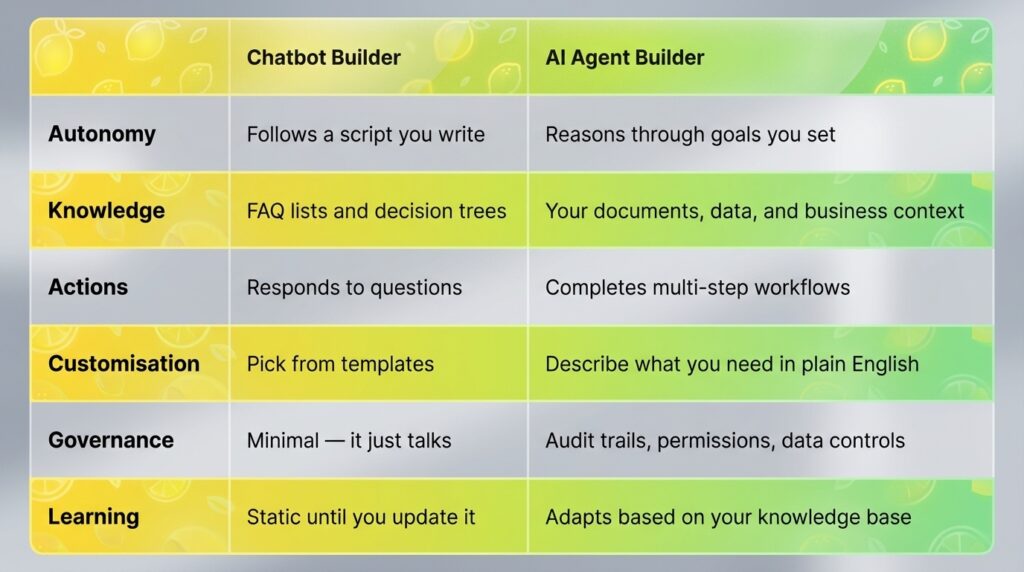
A chatbot answers “What are your business hours?” An AI agent reviews a client’s portfolio, drafts a summary, identifies three risks, and emails you the brief before your morning meeting.
The gap between these two is why the “AI agent builder” category exists at all.
What Can You Build With an AI Agent Builder?
Here’s where it gets practical. These aren’t theoretical use cases they’re things businesses build in their first week.
- Client onboarding assistant
A financial advisor uploads their onboarding checklist and compliance documents. The AI agent walks new clients through the process, collects required information, flags missing documents, and notifies the advisor when everything’s ready for review. What used to take 3 back-and-forth emails now happens in one conversation. - Proposal drafting agent
A management consultant trains an agent on their proposal templates and past client work. When a new lead comes in, the agent researches the company, drafts a tailored proposal, and formats it to the firm’s standards. First draft in 20 minutes instead of 3 hours. - Customer support agent
A small e-commerce business connects their product catalogue, return policy, and shipping FAQ. The AI agent handles 80% of customer queries without escalation, not because it’s scripted for every scenario, but because it understands the business context well enough to reason through new questions. - Knowledge base Q&A
Any business with internal documentation SOPs, training materials, policy documents can build an agent that answers team questions instantly. New hires stop asking the same questions. The team lead stops being a human search engine. - Multi-agent workflow
Advanced use case: multiple agents working together: one researches, one drafts, one reviews. A consulting firm might have a research agent that feeds a proposal agent that feeds a compliance review agent. Each does its job, and the output is better than any single agent could produce.
Who Should Use an AI Agent Builder?
Not everyone needs one. But if any of these sound familiar, you probably do.
- Solo founders drowning in operational tasks. You started a business to do the work you’re great at, and now you spend half your time on admin, emails, and repetitive tasks that don’t grow the business. An AI agent handles the work you keep pushing to “later.”
- Consultants who want to productise their expertise. You’ve got frameworks, templates, and processes that work. An AI agent turns those into a service that runs while you’re with other clients. Your knowledge, scaled without your time.
- Financial advisors who need compliant AI for client data. You can’t use generic AI tools for client-facing work the compliance risk is too high. AI agent builders with governance features (audit trails, data encryption, access controls) let you use AI without the regulatory exposure. Platforms like LaunchLemonade are built specifically for this.
- Agencies building client-facing AI tools. Your clients want AI solutions. You don’t have the engineering team to build custom. An AI agent builder lets you create, brand, and deploy AI agents for clients, and charge for it.
What Should You Look for in an AI Agent Builder?
Not all builders are equal. Here’s the checklist that matters:
- No-code interface. If you need a developer to build or maintain your agents, it’s a tool for engineers, not for you. Look for platforms where you describe what you want in plain English.
- Knowledge base support. Your agent is only as good as what it knows. The platform should let you upload documents, connect data sources, and teach the agent about your specific business.
- Multi-LLM support. Don’t get locked into one AI model. The best platforms let you choose from multiple models (GPT-4, Claude, Gemini, and others) so you can pick the right brain for the job.
- Governance and security. If your agents touch client data, you need audit trails, encryption, role-based access, and data controls. This isn’t optional for regulated industries. It’s the baseline.
- Deployment flexibility. Can you embed the agent on your website? Share it as a link? Use it internally? The more options, the more useful it becomes.
- Transparent pricing. Beware per-message pricing that balloons at scale. Look for predictable monthly costs you can budget around.
How Much Does an AI Agent Builder Cost?
The range is wide, and it matters which end you’re on.
- Custom development: $75,000–$500,000+ upfront, plus ongoing maintenance it takes months and requires a dedicated engineering team. This is what enterprises do, and it’s why most small businesses never built AI agents until recently.
- No-code AI agent builders: $25–$100/month for most small business use cases. You’re live in hours, not months. Industry estimates suggest no-code platforms deliver roughly 80% of the functionality of custom builds at a fraction of the cost.
- Enterprise platforms: $500–$5,000+/month. Built for companies with 1,000+ employees and dedicated IT teams. Features you’ll never use if you’re a team of 5.
For most small businesses and solo operators, a no-code builder in the $25–75/month range is the sweet spot. That’s less than a single hour of a contractor’s time, for a team member that works around the clock.
Frequently Asked Questions
What is the difference between an AI agent and an AI chatbot?
An AI chatbot follows pre-written scripts and responds to specific keywords or decision trees, while an AI agent reasons through problems, connects to your business knowledge, and completes multi-step tasks autonomously. A chatbot tells a customer your return policy an AI agent processes the return.
Do I need coding skills to use an AI agent builder?
No. No-code AI agent builders like LaunchLemonade are designed for non-technical users. You describe what you want the agent to do in plain language, upload your business documents, and the platform handles the technical side.
Can AI agent builders handle sensitive client data securely?
The best ones can, but you need to check. Look for platforms with data encryption (at rest and in transit), audit trails, role-based access controls, and compliance certifications like SOC 2. Not every builder prioritises security, so ask before you commit.
How long does it take to build an AI agent with a no-code builder?
Most users build their first functional agent in 15–60 minutes. A more complex agent with custom knowledge, multiple workflows, and integrations might take a few days to refine. Either way, it’s days, not the months required for custom development.
What industries benefit most from AI agent builders?
Any industry with repetitive knowledge work: financial services, accounting, consulting, legal, real estate, insurance, coaching, and e-commerce. Industries that handle sensitive data benefit most from builders with governance features, since generic AI tools create compliance risk.
Build your first AI agent in 15 minutes, no code, no developers, no risk. Start free on LaunchLemonade →