
No-code AI agent builders let you create AI assistants with visual tools and plain language, no programming. Low-code builders add flexibility with code editors for teams that have developers. If you don’t have a dev team, choose no-code. If you have technical staff who need custom logic, choose low-code. Here’s a full comparison to help you decide.
What Is the Difference Between No-Code and Low-Code AI Agent Builders?
No-code AI agent builders let you create AI assistants using visual interfaces and templates, no programming required. Low-code builders expose the underlying logic so you can customise deeper, but they require some technical skill to use effectively. The distinction matters because it determines who on your team can build and maintain your AI agents, and how fast you can move.
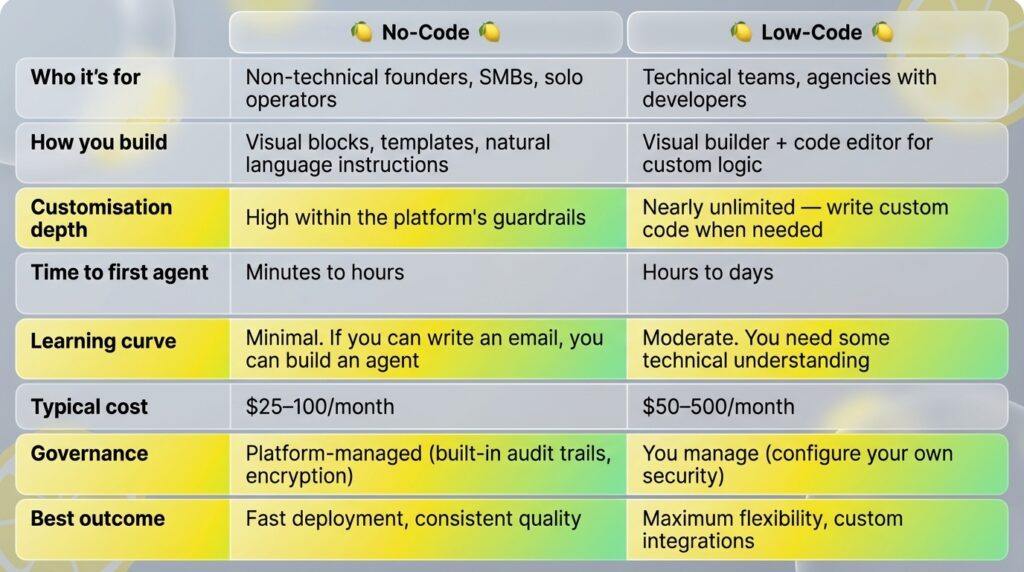
Neither is universally better. The right choice depends on your team, your use case, and how much customisation you actually need.
When Should You Choose a No-Code AI Agent Builder?
Choose no-code if any of these describe your situation: You don’t have developers on your team. This is the simplest test. If nobody on your team writes code, a low-code builder will sit unused or require expensive contractors. No-code platforms like LaunchLemonade let the business owner build and manage agents directly. You need to be live in days, not weeks. No-code platforms are built for speed. Most users build a functional AI agent in their first sitting. When a client opportunity or operational bottleneck demands a fast response, weeks of development time isn’t an option. You’re in a regulated industry and want built-in governance. No-code platforms designed for regulated businesses include audit trails, encryption, and access controls by default. You don’t configure security. It’s baked in. For a financial advisor or accountant handling client data, this reduces risk significantly. You want to delegate tasks to AI, not build custom software. There’s a difference between “I want an AI agent that handles client onboarding” and “I want to build a custom AI application.” No-code is for the first person. Low-code is for the second. Your budget is under $100/month. No-code platforms are designed for SMBs and price accordingly. You’re paying for outcomes (agents that work), not for development environments.
When Should You Choose a Low-Code AI Agent Builder?
Low-code makes sense when your needs outgrow what visual builders offer: You have developers who need flexibility. If your team includes engineers who want to write custom logic, handle edge cases in code, and build proprietary integrations, a no-code platform will feel restrictive. Low-code gives them the visual builder for speed and the code editor for depth. You’re building complex integrations with custom APIs. Connecting to standard tools (email, CRM, calendar) works fine on most no-code platforms. But if you need to integrate with a proprietary internal system, a legacy API, or a custom database, you’ll likely need code. You need granular control over every step. Low-code platforms let you inspect and modify the logic at every stage of an agent’s workflow. For use cases where the exact sequence of actions must be tightly controlled, like financial calculations or legal document processing. This precision matters. You’re building agents for resale or white-labelling. Agencies and developers building AI agents for multiple clients often need the customisation depth that low-code provides. Each client’s agent may need unique logic, branding, and integrations. You want to handle edge cases with custom code. Every business has workflows with exceptions. No-code platforms handle the 80% case well. Low-code handles the remaining 20% the conditional logic, error handling, and branching that visual builders struggle with. Platforms like n8n, Botpress, and Retool are strong options in the low-code category. They’re powerful tools for teams that have the technical skills to use them.
Can No-Code AI Agent Builders Handle Enterprise and Compliance Needs?
This is the most common objection I hear: “No-code sounds limited. Can it handle serious business requirements?” In 2025, the objection was valid. In 2026, it’s outdated. No-code platforms have evolved. LaunchLemonade, for example, supports 21+ language models, includes audit trails and data encryption, offers role-based access controls, and handles multi-agent workflows features that used to require custom engineering. The numbers back this up. Industry estimates suggest no-code platforms deliver roughly 80% of the functionality of custom-built solutions at a fraction of the cost. For most SMBs, that 80% covers everything they need the remaining 20% is typically edge cases that can be handled with workarounds or platform-specific features. The real question isn’t “can no-code handle enterprise needs?”. It’s “does my business actually need the other 20%?” Most small and mid-sized businesses don’t: they need agents that work reliably, handle data securely, and don’t require an engineer to maintain.
What Are the Limitations of Each Approach?
Honesty builds trust, so here are the real limitations, for both sides.
No-Code Limitations
Custom API integrations can be limited. If the platform doesn’t have a pre-built connection to your tool, you may be stuck waiting for them to add it. Some platforms offer webhook or API connectors, but they’re not as flexible as writing custom code. You work within the platform’s logic model. No-code platforms make design decisions about how agents work. If your workflow doesn’t fit their model, you can’t code around it. This rarely matters for standard use cases, but it can be frustrating for unusual ones. Less control over edge case handling. When an agent encounters something unexpected, no-code platforms handle it with their built-in fallback logic. You can’t write custom error handling the way a developer would.
Low-Code Limitations
Requires technical skill to get value. A low-code platform in the hands of a non-technical user is just an expensive subscription. The visual builder gets you started, but the real power requires code. Longer development time. More flexibility means more decisions. More decisions mean more time. What takes 30 minutes on a no-code platform might take 2-3 days on a low-code one, because you’re configuring things the no-code platform handles automatically. Governance is your responsibility. Most low-code platforms give you the tools to build security, but they don’t build it for you. Audit trails, encryption, access controls. You configure and maintain them, and if you get it wrong, that’s your risk. The 60% gap. Industry estimates suggest most low-code platforms get you 40% of the way with the visual builder. The remaining 60% — integrations, compliance, edge cases, production hardening — requires engineering. That’s a meaningful hidden cost.
Frequently Asked Questions
Is no-code AI good enough for business use?
Yes no-code AI agent builders in 2026 handle client onboarding, customer support, proposal drafting, knowledge management, and more. Platforms like LaunchLemonade include governance features that meet the requirements of regulated industries. “No-code” no longer means “toy.”
Do I need a developer to use a low-code AI agent builder?
You can start without one most low-code platforms have visual builders that non-technical users can navigate. But to get full value (custom integrations, complex logic, edge case handling), you’ll need someone who can write code. Budget for at least part-time developer support.
Which is more secure no-code or low-code AI agent builders?
Neither category is inherently more secure what matters is the specific platform’s security implementation. No-code platforms designed for regulated industries often include security by default (encryption, audit trails, access controls). Low-code platforms typically give you the tools to build security, but you configure it yourself, so for teams without security expertise, the no-code approach reduces risk.
Can I switch from no-code to low-code later?
Moving between platforms requires rebuilding your agents there’s no universal standard for portability. However, if you start with no-code and later outgrow it, the knowledge base content (documents, data, instructions) you’ve built is usually transferable. The agent logic itself typically isn’t.
What’s the cost difference between no-code and low-code AI agent builders?
No-code platforms typically range from $25–100/month for SMBs, while low-code platforms range from $50–500/month, but the real cost difference is labour. No-code agents are built and maintained by the business owner, while low-code agents need developer time at $50–200+/hour. Factor in both platform cost and people cost when comparing.
Try LaunchLemonade free build your first AI agent in 15 minutes, no code required. Get started →