
SOC 2 compliance means an AI agent builder’s security controls have been independently audited. If your business handles client data financial records, personal information, confidential documents SOC 2 is the minimum standard you should require. Here’s what to ask, what to verify, and which platforms meet the bar.
Disclaimer: This guide is for informational purposes. Consult your compliance officer or legal advisor for requirements specific to your firm.
What Is SOC 2 and Why Does It Matter for AI Agent Builders?
SOC 2 compliance means an AI agent builder has been independently audited for how it handles your data covering security, availability, processing integrity, confidentiality, and privacy. If you’re building AI agents that touch client data in financial services, accounting, or consulting, SOC 2 isn’t optional. It’s the minimum your clients and regulators expect.
Here’s why this matters specifically for AI agent builders, not just any software:
- Your AI agents process client data actively. Unlike a static database that stores information, AI agents read, reason about, and generate responses based on your client data. Every interaction is a data processing event a fundamentally larger attack surface than traditional software.
- Your AI agents make decisions that affect client outcomes. When an AI agent drafts a portfolio recommendation or summarises a client’s financial situation, the output influences real decisions. If that agent is running on a platform without security controls, you don’t know who else can see that data, or whether the platform is using it to train its models.
- Your clients and regulators will ask. It’s not hypothetical financial advisors answer to the SEC and FINRA, accountants follow AICPA standards, and consultants handling corporate data face contractual security requirements. When your client asks “is the AI tool you’re using secure?” SOC 2 is the answer they’re looking for.
- A breach doesn’t just affect you. If your AI agent platform is compromised and client data leaks, the liability doesn’t stop at the platform. Your business is the one that chose the vendor, shared the data, and faces the regulatory consequences.
What Questions Should You Ask an AI Agent Builder About SOC 2?
Before you sign up for any platform, ask these eight questions. The answers will tell you more about security than any marketing page.
- “Are you SOC 2 Type I or Type II certified?” Type I means an auditor checked their security controls at a single point in time “your setup looks right today.” Type II means an auditor monitored their controls over 6-12 months “your setup works consistently.” Type II is harder to achieve and significantly more trustworthy.
- “Where is my data stored?” Data residency matters for GDPR (EU/UK clients), certain US state regulations, and some industry standards. Know which country and which cloud provider hosts your data. “The cloud” is not an answer.
- “Is data encrypted at rest and in transit?” Both are required: at rest means your stored data is encrypted (look for AES-256 as the standard), and in transit means data moving between your browser and the platform is encrypted (look for TLS 1.2 or higher). If the platform can’t name their encryption standards, that’s a red flag.
- “Do you log all agent actions?” Audit trails are non-negotiable for regulated businesses. Every action your AI agent takes. Every response generated, every document accessed, every decision made should be logged with timestamps and user identifiers. These logs are your compliance evidence if a regulator or client ever asks what happened.
- “Can I control who accesses what?” Role-based access controls let you define who on your team can view, edit, or interact with specific agents and data. An intern shouldn’t have the same access as a senior advisor. If the platform gives everyone the same permissions, it’s not ready for regulated use.
- “What happens to my data if I leave?” Data portability and deletion policies matter can you export your data, how long does the platform retain it after you cancel, and do they delete it completely or does it persist in backups? Get this in writing.
- “Do you use my data to train AI models?” This is the question most people forget to ask, and it’s critical. Many platforms use customer data to improve their AI models, and if your client’s financial data is feeding a training dataset, that’s a confidentiality breach regardless of anonymisation. The answer you want is an unambiguous “no.”
- “Which LLMs do you use, and what are their data policies?” The platform might be secure, but the underlying AI model may not be. If the platform sends your data to an LLM provider, you need to know that provider’s data handling policies too does the LLM provider retain your prompts or use them for training? Some platforms support 21+ LLMs and let you choose models with data policies that match your compliance requirements.
Which AI Agent Builders Have SOC 2 Compliance in 2026?
Here’s what I’ve been able to verify from public documentation. If a platform’s status is listed as “unverified,” it means I couldn’t confirm their certification from publicly available sources, not that they don’t have it.
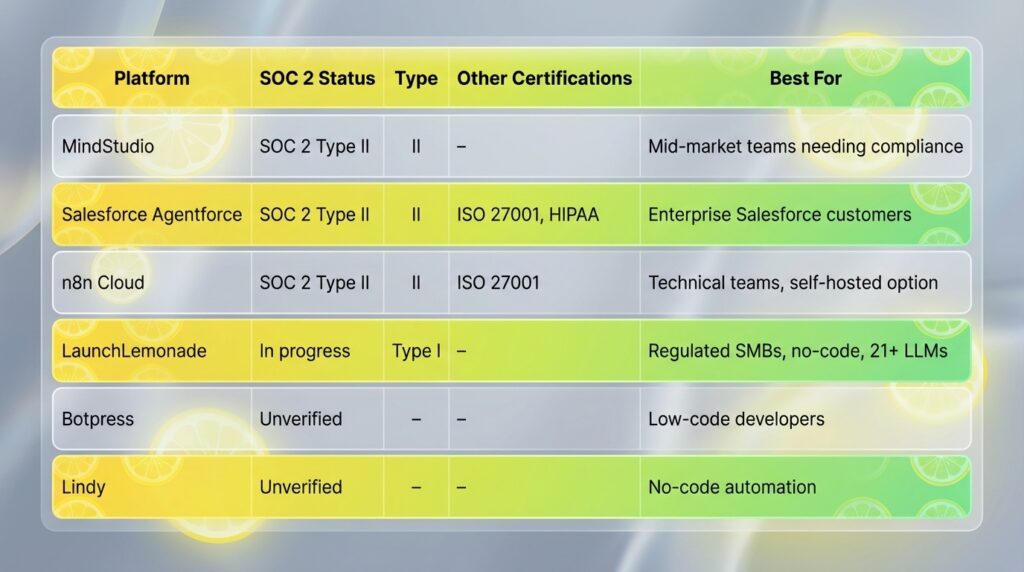
A note on LaunchLemonade’s status: We’re pursuing SOC 2 Type I certification, targeted for completion in H1 2026 I’m being transparent about this because honest numbers matter more than impressive claims. Our platform includes encryption, audit trails, and access controls today. The SOC 2 certification is the independent verification that our controls meet the standard.
What’s the Difference Between SOC 2 Type I and Type II?
This distinction confuses most buyers, but it’s straightforward:
- SOC 2 Type I is a snapshot. An independent auditor examines your security controls at a specific point in time and confirms they’re properly designed. Think of it as a home inspection “the house looks structurally sound today.”
- SOC 2 Type II is a movie, not a photo. The auditor monitors your controls over a sustained period (typically 6-12 months) and confirms they work consistently. It’s the difference between “the house looks safe” and “we watched it through a full year of weather and it held up.”
What this means for your decision:
- Type I is a meaningful baseline. It proves the platform takes security seriously enough to undergo an audit.
- Type II is the gold standard. It proves the security isn’t just designed well it actually works over time.
- If a platform has Type I but not Type II, they’re on the right path. Ask when Type II is expected.
- If a platform has neither, ask why.
Is SOC 2 Enough for Regulated Industries?
Honest answer: SOC 2 is the floor, not the ceiling.
SOC 2 proves the platform handles your data securely. But depending on your industry, you may face additional requirements that SOC 2 doesn’t cover:
- Financial services. SEC, FINRA, and state regulations have specific requirements about client data handling, recordkeeping, and supervision. SOC 2 covers the platform. It doesn’t cover your regulatory obligations for how you use the platform.
- Healthcare. HIPAA requires specific protections for protected health information (PHI). SOC 2 and HIPAA overlap on security, but HIPAA has unique requirements around patient data access, breach notification, and business associate agreements.
- Legal. Attorney-client privilege creates obligations that go beyond standard data security. The platform must ensure that privileged communications processed by AI agents remain protected.
- Accounting. AICPA standards govern how client financial data is handled. Your firm’s peer review may ask about the security posture of tools you use.
Think of it this way: SOC 2 proves the kitchen is clean. Your industry’s regulations determine what you’re allowed to cook.
How Can Small Firms Afford SOC 2 Compliant AI Agent Builders?
The perception that SOC 2 compliant tools cost a fortune comes from enterprise pricing. Salesforce, Kore.ai, and Rasa charge enterprise rates $500 to $5,000+ per month, because they’re built for organisations with 1,000+ employees.
But SOC 2 compliance doesn’t require enterprise pricing. No-code platforms serve the same security standard at SMB price points. LaunchLemonade’s plans start at $25-75/month, and include the same encryption, audit trails, and access controls that enterprise platforms charge 10-50x more for.
The cost calculation that matters isn’t “how much does the platform cost?” It’s “how much does a security incident cost?”
For a financial advisory firm, a single client data breach can mean:
- Regulatory fines (SEC penalties range from $50,000 to millions)
- Client lawsuits and settlements
- Mandatory breach notifications to every affected client
- Reputational damage that takes years to recover from
- Potential loss of your license to operate
Against that backdrop, $75/month for a platform with real security controls isn’t an expense. It’s insurance.
Frequently Asked Questions
What does SOC 2 compliance mean for an AI agent builder?
It means an independent auditor has verified that the platform’s security controls meet the standards set by the American Institute of CPAs (AICPA) across five trust service criteria: security, availability, processing integrity, confidentiality, and privacy. It’s the most widely recognised security certification for SaaS platforms.
Do I need SOC 2 if I’m a solo financial advisor?
Your regulatory obligations don’t scale down with your team size. SEC and FINRA require appropriate safeguards for client data regardless of whether you’re a solo advisor or a 500-person firm. SOC 2 is the easiest way to demonstrate to regulators (and clients) that your tools meet that standard.
Can I use an AI agent builder that isn’t SOC 2 compliant?
Technically, yes, no law requires your AI tools to have SOC 2 specifically. But if you handle client data in a regulated industry, you need to demonstrate adequate security controls, and SOC 2 is the standardised way to prove it. Without it, you’re asking clients and regulators to trust your vendor’s marketing materials instead of an independent audit.
How long does it take for an AI platform to get SOC 2 certified?
Type I typically takes 3-6 months from the start of preparation, and Type II requires an additional 6-12 months of monitoring after that. The full journey from “we decided to get SOC 2” to “we have Type II” is usually 12-18 months. Platforms that have Type II have invested significantly in their security infrastructure.
What’s the difference between the platform being SOC 2 compliant and the AI model being secure?
Important distinction. SOC 2 certifies the platform how it stores, transmits, and handles your data, but the platform sends your data to an underlying AI model (GPT-4, Claude, Gemini, etc.) for processing, and that model provider has its own data policies. A SOC 2 compliant platform using an AI model that trains on your data still creates a confidentiality risk. Ask about both layers.
See how LaunchLemonade handles security and governance — explore our compliance features →