
The best AI agent builder for regulated industries depends on your team size and technical resources. For regulated SMBs (financial advisors, accounting firms, consultants) who need governance without a dev team, the right platform matters more than the biggest brand name. For enterprises with engineering teams who need self-hosted deployment, Rasa leads. For mid-market with technical staff, StackAI and MindStudio are strong options. Here’s how to evaluate them.
Why Do Regulated Industries Need a Different AI Agent Builder?
The best AI agent builder for regulated industries combines no-code simplicity with enterprise-grade governance audit trails, data encryption, role-based access, and compliance controls that satisfy regulators without requiring a dedicated IT team. For financial advisors, accounting firms, and consultants handling sensitive client data, the platform you choose must be built for compliance from day one, not bolted on as an afterthought. Generic AI agent builders are built for speed and flexibility. That’s fine if you’re automating social media posts. It’s not fine if you’re handling client portfolios, tax documents, or legal contracts.
The risks are specific and serious:
- Client data exposure. An agent trained on client financials needs encryption, access controls, and data residency guarantees. Most builders don’t offer this.
- Regulatory violations. Financial advisors answer to the SEC and FINRA. Accountants follow AICPA standards. Using an AI tool without audit trails isn’t just risky. It’s potentially a compliance violation.
- Audit failures. If a regulator asks “what did your AI tell this client, and why?”. You need a platform that can answer that question with a complete activity log. This is why “best AI agent builder” lists written for general audiences miss the point for regulated businesses. The evaluation criteria are fundamentally different.
What Should Regulated Businesses Look for in an AI Agent Builder?
Before comparing platforms, get clear on what matters. These are the eight non-negotiables for any business handling sensitive data:
- Audit trails and activity logging. Every action your AI agent takes should be logged what it said, what data it accessed, what decisions it made, and when. This is your compliance evidence.
- Data encryption at rest and in transit. Your client data should be encrypted when stored and when moving between systems. Look for AES-256 encryption and TLS 1.2+ as minimums.
- Role-based access controls. Not everyone on your team should access every agent or every dataset. The platform should let you set granular permissions.
- Compliance certifications. SOC 2 is the baseline, HIPAA matters for healthcare-adjacent work, and ISO 27001 is the international equivalent. Ask what the platform has, and verify it.
- Data residency options. Some regulations require data to stay within specific geographic boundaries. If you serve UK or EU clients, GDPR data residency matters.
- No-code interface. Regulated SMBs don’t have dev teams. If the platform requires engineers to build and maintain agents, it’s not a fit for a 5-person accounting firm.
- Multi-LLM support. The AI model landscape changes fast. If your platform locks you into one model, you can’t adapt when a better option arrives, or when your current model’s data policies change.
- Human-in-the-loop controls. For high-stakes decisions (client advice, compliance-sensitive communications), your agents should be able to flag items for human review before acting.
Which AI Agent Builders Work for Regulated Industries in 2026?
Here’s the honest comparison. I’ve evaluated these based on what regulated SMBs actually need, not what enterprise IT teams want.
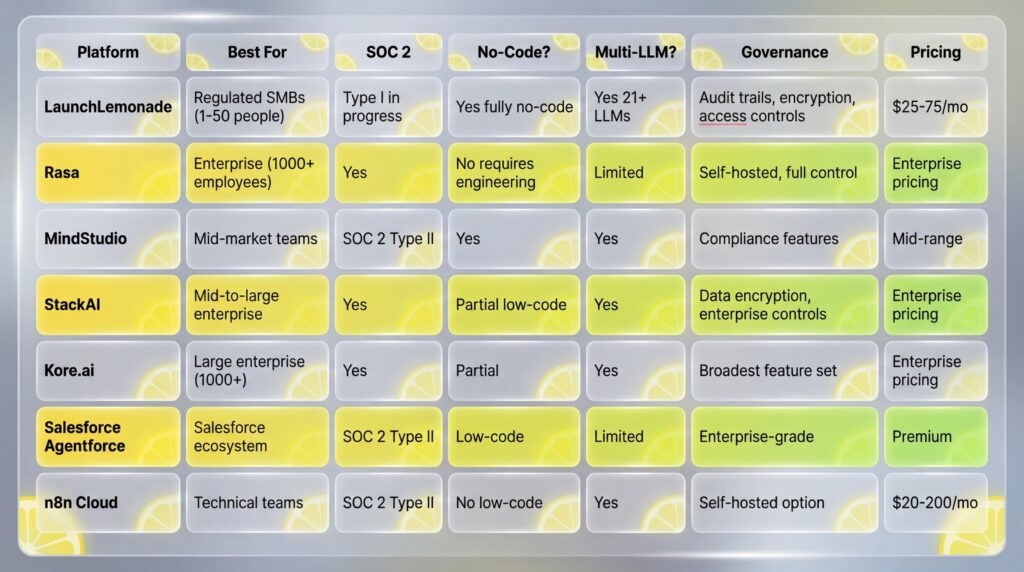
A few things stand out. Enterprise platforms (Rasa, Kore.ai, Salesforce) are built for organisations with engineering teams, six-figure budgets, and months to implement. That’s not wrong. It’s just not relevant if you’re a 10-person financial advisory firm.
On the other end, most no-code platforms skip governance entirely. They’re fast to set up but expose you to compliance risk.
The gap in the middle governance-grade security in a no-code package at SMB pricing is where the real opportunity lives for regulated SMBs.
When Should You Choose LaunchLemonade Over Enterprise Platforms?
LaunchLemonade is the right fit when:
- Your team is 1-50 people. You don’t have a dedicated IT department or engineering team. You need something you can set up yourself and manage without technical support.
- You need governance but not enterprise complexity. Audit trails, encryption, and access controls, without the six-month implementation timeline and custom contracts.
- You want to be live in days, not months. Enterprise platforms require procurement cycles, technical integration, and customisation. A no-code governed platform gets you from signup to working agent in an afternoon.
- Your budget is $25-75/month, not $50K+ annually. Enterprise pricing reflects enterprise features you’ll never use. You’re paying for a 5-person team’s needs, not a 5,000-person organisation’s.
- You need multi-LLM flexibility. The platform supports 21+ language models. Your agents can use the best model for each task, and you can switch without rebuilding.
If you’re a Fortune 500 company with an engineering team and enterprise procurement, Rasa or Salesforce are built for you. But if you’re a financial advisor, fractional CFO, or consulting firm? The enterprise approach is like hiring a 747 to fly across town.
What Are the Biggest Mistakes Regulated Businesses Make When Choosing an AI Agent Builder?
I see the same five mistakes repeatedly:
- Choosing based on features, not governance. The platform with the most integrations and the flashiest demo isn’t necessarily the safest. Features are easy to compare. Security posture requires asking harder questions.
- Using consumer AI tools for client-facing work. Pasting client data into ChatGPT or Claude without a governed wrapper is a compliance risk. These models are powerful, but they weren’t designed to meet your regulatory obligations on their own.
- Assuming “enterprise” means “compliant.” Enterprise platforms are built for scale, but compliance is a separate question. Some enterprise platforms have excellent governance others just have excellent marketing about governance.
- Ignoring data residency requirements. If your clients are in the UK or EU, GDPR has specific rules about where data is stored and processed. Ask before you build, not after a regulator asks you.
- Not asking about audit trails until after an incident. The time to verify your platform logs agent activity is before you need the logs, not when a client complaint or regulatory inquiry arrives.
Frequently Asked Questions
What compliance certifications should an AI agent builder have?
SOC 2 is the baseline it means the platform’s security controls have been independently audited. For healthcare-adjacent work, HIPAA compliance matters, and ISO 27001 is the international security management standard. Ask the platform for their current certifications and verify independently.
Can small regulated businesses afford enterprise-grade AI agent builders?
Yes. If you choose the right category. Enterprise platforms charge $500-$5,000+/month because they’re built for large organisations. No-code platforms with governance features start at $25-75/month, making compliant AI accessible to firms that previously couldn’t justify the cost.
Is it safe to use AI agents with sensitive financial client data?
It can be, with the right platform. The platform must encrypt data at rest and in transit, log all agent actions, enforce access controls, and provide clear data handling policies, and the underlying AI models should not train on your client data. Ask these questions explicitly before committing.
What’s the difference between a compliant AI agent builder and a compliance tool?
A compliance tool (like Vanta or Drata) helps you manage your own compliance processes evidence collection, audit prep, monitoring. A compliant AI agent builder is a platform you build AI agents on, where the platform itself meets compliance standards. You may need both, but they solve different problems.
How do AI agent builders handle audit trail requirements?
The best platforms log every interaction: what the agent said, what data it accessed, what actions it took, timestamps, and user identifiers. These logs should be exportable and searchable. If a platform can’t show you their audit trail capabilities in a demo, that’s a red flag.
See how LaunchLemonade handles governance for regulated teams start your free trial →