Every small business owner eventually faces this question: should I hire someone or use AI?
I’ve been on both sides. I run a 2-person company that serves hundreds of businesses. Two years ago, I would have needed a team of 8-10 people to do what we do today. The honest answer to the hiring question is: it depends on what the work actually involves.
Here’s the breakdown I wish someone had given me.
The Full Cost of Hiring a Person
Most people think about salary. The actual cost is much higher.
Junior Virtual Assistant (Remote, Full-Time)
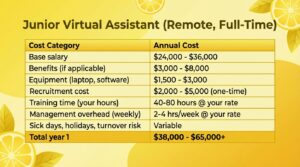
And that’s before accounting for the lag time. A new hire takes 2-4 weeks to onboard, 2-3 months to reach full productivity, and might leave after 6 months.
Junior In-House Employee (US/UK)
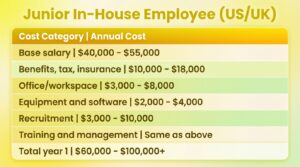
The Full Cost of AI Delegation
AI Platform (e.g., LaunchLemonade Team Plan)
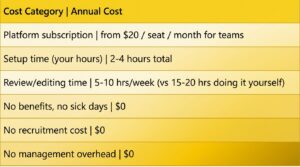
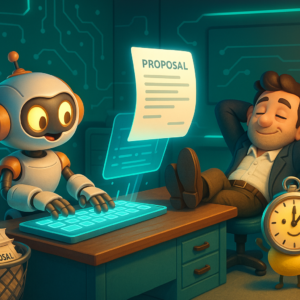
The cost difference: $900 vs $38,000-$100,000. That’s 97-99% cheaper.
But cost isn’t everything.
What AI Does Better
Speed: AI completes a research brief in 3 minutes. An untrained junio takes 1-2 hours.
Consistency: AI follows your template perfectly every time. Humans have good days and bad days.
Availability: AI works at 3am on a Sunday. Humans don’t (and shouldn’t have to).
Scalability: AI handles 50 research briefs as easily as 5. Humans have capacity limits.
Cost predictability: From $20/ seat/ month, every month. No raises, no turnover, no severance.
What Humans Do Better
Judgment: Should we take this client? Is this strategy right? Humans make nuanced decisions.
Relationships: Clients want to talk to a person. Trust is built human-to-human.
Creative strategy: AI can draft, but the creative vision, the brand voice, the emotional hook, the strategic insight, comes from humans.
Complex negotiation: Pricing discussions, partnership terms, conflict resolution.
Empathy: Handling sensitive situations, reading the room, delivering difficult messages.
The Hybrid Model: What Actually Works
The answer for most small businesses isn’t AI OR human. It’s AI AND human, each doing what they do best.
AI handles:
- Client research and meeting prep
- First drafts of proposals, emails, reports
- Data compilation and formatting
- Routine customer FAQ responses
- Content calendar drafts
Humans handle:
- Client relationship management
- Strategic decision-making
- Creative direction and brand voice
- Complex problem-solving
- Quality review and final sign-off
The result: Your human team spends 100% of their time on high-value work. The mundane, repetitive tasks that burn people out? AI takes those.
Decision Framework: When to Hire vs When to Use AI
Use AI when the task is:
- Repetitive and follows a pattern
- Template-based with predictable output
- Research or data-heavy
- First-draft work (not final deliverables)
- High-frequency (done daily or weekly)
Hire a human when the task requires:
- Ongoing relationship management
- Creative judgment that changes per situation
- Physical presence or in-person interaction
- Complex multi-stakeholder coordination
- Deep domain expertise that can’t be templated
Use both when:
- Volume is high and quality matters (AI drafts, human reviews)
- You need coverage outside business hours (AI covers nights/weekends)
- Tasks have both structured and creative components
Frequently Asked Questions
Can AI replace a virtual assistant?
- AI can replace the task-based work that virtual assistants typically handle: email management, research, scheduling, data entry, and first-draft writing. However, AI cannot replace the relationship management, judgment, and complex coordination that experienced VAs provide. Many businesses use AI for the structured tasks and a part-time VA for the rest, reducing their VA hours (and cost) by 50-70%.
When should a small business hire instead of using AI?
- Hire when the role primarily involves relationship management, creative strategy, complex decision-making, or physical presence. If the job is mostly about judgment and relationships (sales, account management, creative direction), you need a human. If the job is mostly about structured task execution (research, drafting, data compilation), AI is more cost-effective.
How much time does it take to manage AI compared to managing an employee?
- AI requires minimal management: 15-30 minutes of initial setup, then 5-10 minutes per task for review and feedback. A human employee requires 2-4 hours per week of management time (check-ins, feedback, training, task assignment). AI has no onboarding period, no performance reviews, and no turnover risk.
Can I use AI and then hire later as my business grows?
- Absolutely. This is the recommended approach. Start with AI for your most time-consuming repetitive tasks. As your business grows and you need human judgment, relationships, and creativity at scale, hire for those roles while keeping AI for the structured work. This way, every hire focuses on high-value work from day one.
Why pay $50,000 for tasks that cost $900?
Cien Solon is the founder and CEO of LaunchLemonade, building AI team members for every business. Follow her on LinkedIn for daily insights on AI, delegation, and building in public.