
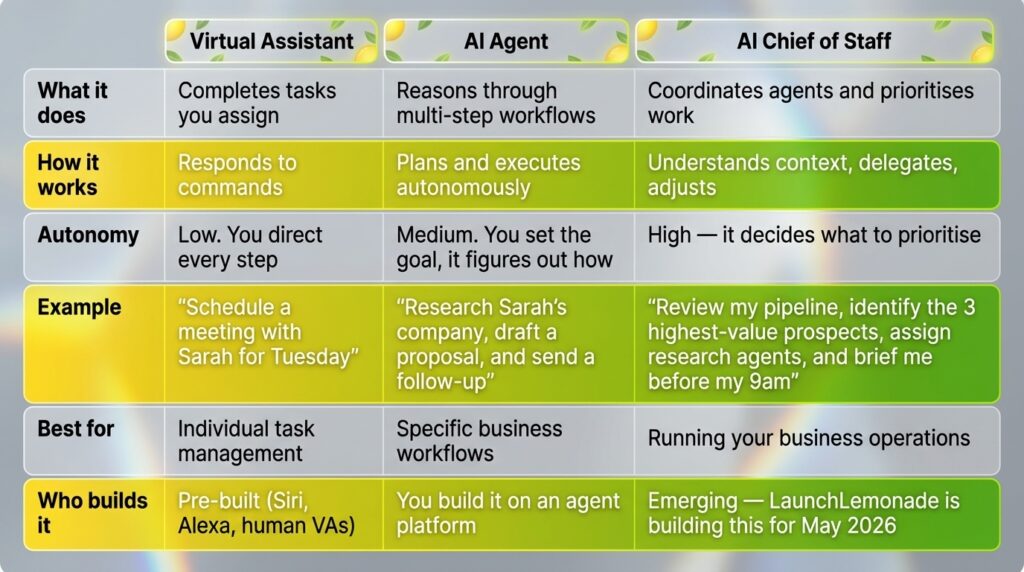
A virtual assistant handles tasks you assign: one at a time, reactively. An AI agent reasons through multi-step workflows autonomously. An AI Chief of Staff coordinates multiple agents, understands your priorities, and decides what to delegate, like a strategic right hand for your business. Here’s when you need each one.
What Is the Difference Between a Virtual Assistant, an AI Agent, and an AI Chief of Staff?
A virtual assistant handles tasks you assign scheduling meetings, answering emails, managing your calendar. An AI agent goes further by reasoning through multi-step workflows autonomously. An AI Chief of Staff does what neither can: it understands your priorities, coordinates multiple agents, and makes delegation decisions on your behalf, like a strategic right hand that knows your business.
These three categories represent an evolution, not a competition. Most businesses will use all three at different stages, and the differences matter when you’re deciding what to invest in.
When Should You Use a Virtual Assistant?
Virtual assistants are the entry point. They’re good at simple, clearly defined tasks where you know exactly what you want done.
Best for:
- Calendar management and scheduling
- Setting reminders and timers
- Quick information lookups
- Email triage (basic sorting, not strategic response)
- Voice-activated convenience (smart home, quick questions)
Consumer virtual assistants Siri, Google Assistant, Alexa handle personal productivity well. Human virtual assistants from services like Belay or Time Etc handle business admin tasks that require judgment but not deep expertise.
The limitation: Virtual assistants are reactive. They wait for your instruction, complete one task, then wait again. They don’t plan ahead, connect tasks together, or adapt to changing priorities. Every action requires your direction.
For a solo founder managing a growing business, this model breaks down fast. You spend more time delegating than you save on execution. That’s the signal to move to AI agents.
When Should You Use an AI Agent?
AI agents are the current sweet spot for most businesses. They handle specific workflows autonomously. You define the goal, and the agent figures out how to get there.
Best for:
- Client onboarding (collecting documents, answering questions, routing)
- Proposal and report drafting (research + writing + formatting)
- Customer support (understanding context, not just matching keywords)
- Knowledge base Q&A (answering team or client questions from your documents)
- Data research and summarisation
The key difference from virtual assistants: an AI agent connects to your business knowledge, reasons through multi-step tasks, and handles complexity without step-by-step direction.
A financial advisor using a virtual assistant says: “Send the onboarding checklist to new client Jane Smith.” An AI agent handles it differently: given that Jane Smith signed her advisory agreement, the agent automatically sends the onboarding checklist, collects her risk tolerance questionnaire, cross-references her responses with the firm’s model portfolios, flags any compliance concerns, and notifies the advisor when everything’s ready for review.
Same outcome, fundamentally different level of autonomy.
This is where governed no-code platforms operate today letting non-technical business owners build AI agents that handle specific workflows with security built in.
When Will You Need an AI Chief of Staff?
Once you have multiple agents handling different parts of your business, a new problem emerges: who coordinates them?
An AI Chief of Staff is the orchestration layer. It knows your priorities, assigns work to the right agents, and surfaces what needs your attention. Think of it as the difference between having employees and having a manager.
The AI Chief of Staff handles:
- Reviewing your day and pre-assigning work to the right agents
- Prioritising tasks based on business impact, not just urgency
- Flagging conflicts (two agents need the same data, a deadline overlaps with a client meeting)
- Summarising what happened while you were offline
- Making delegation decisions you’d otherwise make yourself
This isn’t science fiction. The category is emerging now. The Deep View called it the shift from “virtual assistant” to “AI chief of staff” — reflecting that AI is moving from task completion to strategic coordination.
LaunchLemonade is building an AI Chief of Staff product, targeting launch in May 2026. The concept: if you’ve already built AI agents for client onboarding, proposal drafting, and research, the Chief of Staff coordinates them into a cohesive operation, so you manage one system, not five separate agents.
How Does an AI Chief of Staff Actually Work?
Here’s what a realistic day could look like for a financial advisor using an AI Chief of Staff (this is the experience we’re building toward with our May 2026 launch):
7:00 AM Before you open your laptop.
Your AI Chief of Staff reviewed overnight emails. It identified a new client inquiry, a portfolio alert from a market movement, and a compliance deadline reminder. It already assigned your research agent to pull background on the new prospect and flagged the compliance deadline as high priority.
8:00 AM. Your morning briefing.
You get a summary: “3 items need your attention today. The Johnson portfolio needs rebalancing after yesterday’s market shift I’ve drafted a recommendation. New prospect Sarah Chen reached out research is ready. Your Q1 compliance filing is due Friday documents are 80% prepared.”
9:00 AM. You review, adjust, and go.
The Chief of Staff didn’t make decisions for you it prepared everything so your decisions take minutes instead of hours. You approve the portfolio recommendation, review the prospect research, and check the compliance filing. Three hours of work, compressed into 30 minutes of review.
Throughout the day.
As new tasks arrive client calls, emails, document requests the Chief of Staff routes them to the appropriate agent or flags them for your direct attention based on priority and sensitivity.
This isn’t about replacing your judgment. It’s about eliminating the overhead of figuring out what to work on, in what order, with what information. The strategic decisions stay with you; the coordination disappears.
Can Small Businesses Use an AI Chief of Staff?
A chief of staff used to be reserved for presidents, heads of state, and Fortune 500 CEOs. The title implied a large organisation with complex operations that needed a senior person coordinating across departments.
AI changes the economics completely.
A solo financial advisor with 50 clients has the same coordination challenges as a larger firm, just fewer resources. They’re juggling client onboarding, portfolio reviews, compliance filings, prospect research, and client communications. The complexity doesn’t scale down with team size, but the help does.
An AI Chief of Staff gives a 5-person firm the operational coordination that used to require a 50-person firm’s infrastructure. Not because AI replaces people, but because it handles the coordination work that no one has time for.
The entry point isn’t “build a Chief of Staff from scratch.” It’s: start with individual AI agents for your most repetitive workflows. Once you have 3-4 agents working, the Chief of Staff becomes the layer that ties them together.
Frequently Asked Questions
What is an AI Chief of Staff?
An AI Chief of Staff is an orchestration layer that coordinates multiple AI agents, understands your business priorities, and makes delegation decisions on your behalf. It reviews incoming work, assigns tasks to the right agents, prioritises based on business impact, and surfaces what needs your direct attention. Think of it as the manager for your AI team.
How is an AI agent different from a virtual assistant?
A virtual assistant responds to direct commands and handles one task at a time — “schedule this meeting,” “send this email.” An AI agent reasons through multi-step workflows autonomously. You set the goal (“onboard this new client”), and the agent plans the steps, connects to your data, and executes without needing direction at every stage.
Do I need multiple AI agents before using an AI Chief of Staff?
Yes an AI Chief of Staff coordinates agents. If you only have one agent, you don’t need coordination. The typical path is: start with 1-2 agents for your biggest pain points, add more as you identify repetitive workflows, then layer in the Chief of Staff when managing multiple agents becomes its own time cost.
Is an AI Chief of Staff the same as an AI copilot?
No. An AI copilot works alongside you on a specific task suggesting edits in a document, writing code, or drafting emails, and it’s reactive and single-task. An AI Chief of Staff is proactive and cross-functional: it doesn’t help with one task, it coordinates your entire operation. Copilot is a better colleague; Chief of Staff is a better manager.
When will AI Chief of Staff products be available?
The category is emerging in 2026 LaunchLemonade is building an AI Chief of Staff product targeted for launch in May 2026. Some enterprise platforms offer orchestration features today, but purpose-built AI Chief of Staff products for SMBs are just arriving. Start building individual AI agents now so they’re ready to coordinate when the Chief of Staff layer is available.
Start with AI agents today build your first one free on LaunchLemonade. When AI Chief of Staff launches, your agents will be ready. Get started →