
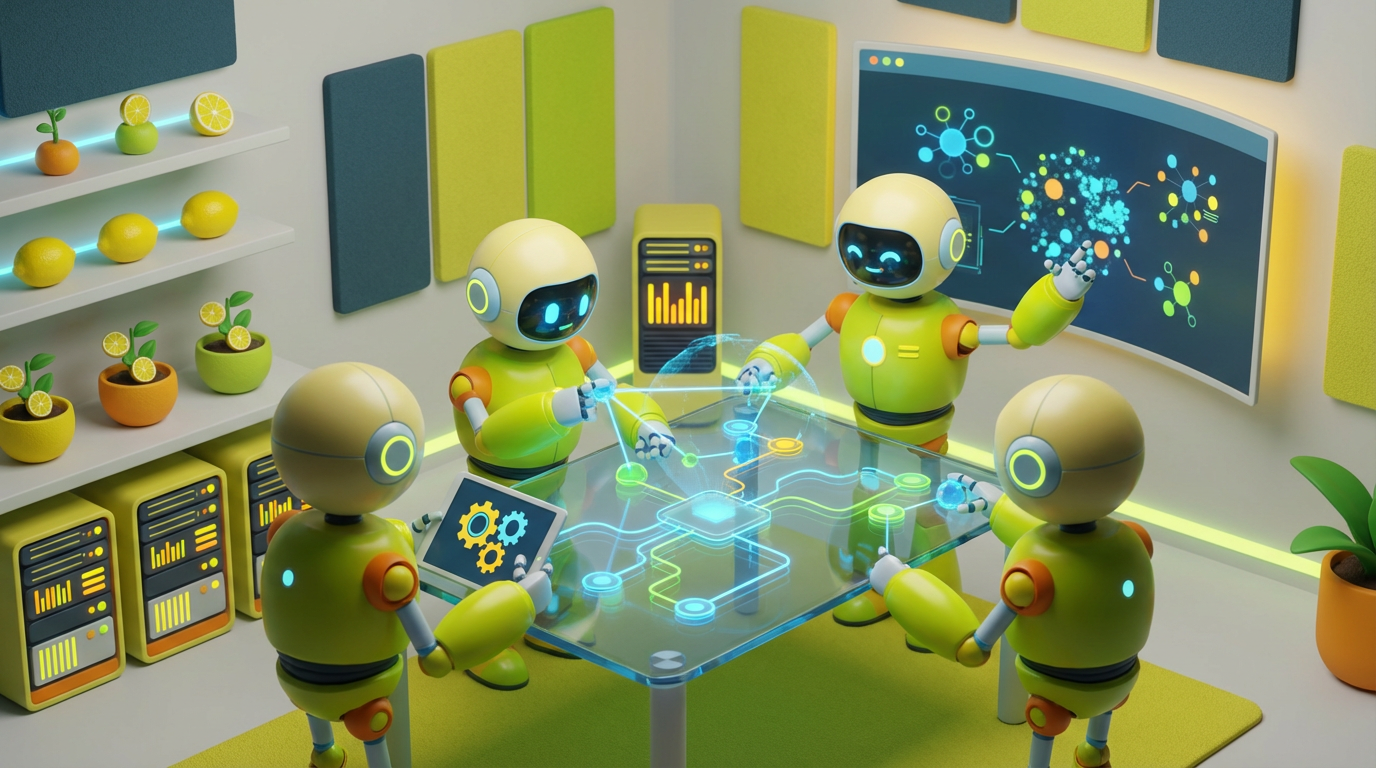
The true potential of AI in an organizational setting goes beyond a single, powerful AI agent. Just as a complex business problem rarely has a single solution, it often requires a coordinated effort from multiple specialists. This is the philosophy behind a multi-agent workflow: an orchestrated system where several specialized AI agents collaborate, communicate, and hand off tasks to solve intricate business problems more efficiently and effectively than any single agent or human could alone. Our team recently embarked on building our first multi-agent workflow, and the experience was transformative, enabling us to tackle a challenge that previously consumed significant manual effort.
This dive into a multi-agent workflow unlocked a new level of automation and problem-solving capability.
The Challenge: Manual, Multi-Stage Content Research & Creation
Our content creation process was a prime candidate for a multi-agent workflow. It involved several distinct stages, each requiring specialized skills and often causing bottlenecks:
-
Topic Research: Identifying trending keywords, competitor content, and audience interests.
-
Outline Generation: Structuring the content based on research and SEO best practices.
-
Initial Draft Creation: Writing the core content, often requiring factual checks.
-
Brand Voice & Tone Alignment: Ensuring the draft met our specific brand guidelines.
-
SEO Optimization: Adding internal links, meta descriptions, and further keyword integration.
-
Image Sourcing: Finding relevant, copyright-free images.
Each stage involved manual handoffs, context switching, and potential for inconsistencies. We aimed to build our first multi-agent workflow to streamline this.
Designing Our First Multi-Agent Workflow: The Content Generator Ensemble
We designed a multi-agent workflow, which we affectionately called “The Content Generator Ensemble,” comprising several specialized AI agents orchestrated together. We used a no-code AI platform, LaunchLemonade, for its flexibility in chaining agents.
The Agents in Our Ensemble:
-
The Research Agent (Chief Investigator):
-
Role: Market and Competitor Intelligence gatherer.
-
Task: Takes a general topic as input. Scours multiple online sources, identifies trending sub-topics, relevant keywords, and analyzes competitor content performance.
-
Outputs: A comprehensive research report, including a list of high-ranking keywords, competitor content analysis, and audience interest data.
-
-
The Outline Agent (Architect):
-
Role: Content Structure Designer.
-
Task: Receives the research report from the Research Agent. Based on our internal SEO best practices and content format guidelines, generates a detailed, SEO-optimized outline with headings, subheadings, and key points to cover.
-
Outputs: A structured content outline, including suggested word count for each section and target keywords.
-
-
The Drafting Agent (First Wordsmith):
-
Role: Initial Content Creator.
-
Task: Takes the outline from the Outline Agent. Generates a first draft of the article, ensuring it covers all key points, maintains factual accuracy using its access to verified sources, and meets basic readability standards.
-
Outputs: A full article draft, ready for a human to refine.
-
-
The Brand Voice Agent (Brand Guardian):
-
Role: Brand Tone and Style Enforcer.
-
Task: Receives the article draft from the Drafting Agent. Compares it against our comprehensive brand voice and style guide. Flags deviations in tone, word choice, and suggests revisions for alignment. It also checks for grammatical errors and clarity.
-
Outputs: An edited draft with suggestions for brand voice and grammar correction.
-
-
The SEO Agent (Optimizer):
-
Role: Search Engine Optimization Specialist.
-
Task: Receives the brand-aligned draft. Optimizes the content further for SEO, including suggesting internal and external links, crafting meta descriptions, and ensuring optimal keyword density.
-
Outputs: The final, SEO-optimized content, ready for a human editor.
-
Orchestrating Our First Multi-Agent Workflow
The orchestration was crucial. We built a supervisor, “Master Agent” on LaunchLemonade that receives the initial topic and intelligently hands off tasks between these specialized agents:
-
Human Input: A team member provided the Master Agent with a content topic, for example, “The Future of AI in Small Business.”
-
Master Agent to Research Agent: The Master Agent sends the topic to the Research Agent.
-
Research Agent Completes Task > Returns to Master Agent: The Research Agent performs its task and returns the research report to the Master Agent.
-
Master Agent to Outline Agent: The Master Agent then sends the research report to the Outline Agent.
-
Sequence Continues: This sequential handoff continues through the Drafting, Brand Voice, and SEO Agents.
-
Human Review: The Master Agent then presents the fully prepared, SEO-optimized, brand-aligned draft to a human editor for final review and polish.
The Impact: Content Creation Transformed
Building our first multi-agent workflow was a game-changer for our content team:
-
90% Reduction in Drafting Time: The initial drafts, which typically took hours, were generated in minutes.
-
Enhanced Consistency: Brand voice and SEO best practices were consistently applied across all initial content.
-
Increased Scope: We could produce a significantly higher volume of high-quality, targeted content.
-
Human Focus Shifts: Our human content creators moved from initial research and drafting to higher-value activities: strategic refinement, creative storytelling, and adding unique insights that only a human can provide.
-
Faster Iteration: The speed of the multi-agent workflow allowed for quicker content iterations and A/B testing of various approaches.
This multi-agent workflow didn’t just automate tasks; it transformed our entire content creation pipeline. It leveraged the unique strengths of each specialized AI agent, orchestrating them into a cohesive, highly efficient system. For any team looking to tackle complex, multi-stage problems, building a multi-agent workflow is the next frontier in AI-driven productivity.



